
Build a Graves County Former-Owner Timeline
A backward chain begins with the newest recorded deed. The table is a worksheet only. Fill one row from each verified instrument and retain its precise reference.
| Transfer date | Grantor → grantee | Instrument | Reference |
|---|---|---|---|
| Newest verified date | Previous owner → current grantee | As indexed | Book/page or instrument number |
| Earlier date | Earlier owner → previous owner | As indexed | Exact Clerk citation |
| Earlier date | Prior grantor → earlier owner | As indexed | Exact Clerk citation |
Check names twice. A grantor may have conveyed only part of a tract, so the legal description, acreage, lot and block, plat reference and adjoining-owner calls must all match before rows join.
Start with Graves County's Latest Grantee
Open the Graves PVA qPublic application first. Note the current owner, situs, mailing address, parcel number and abbreviated legal description. Then switch to the Clerk's ECCLIX route. Locate that owner's incoming conveyance there. The latest recorded grantee received the stated interest, and that person's grantor is the first former owner to chase.
Never trust a PVA last-sale field alone. The indexed deed is the authority. Confirm the parties, recording date and description there, especially when the card shows an LLC, trust, estate or fiduciary.
Note: Try initials, punctuation and entity-suffix variants when an exact owner-name query returns no deed entry.
Turn Each Graves Grantee into the Next Grantor
- Open the latest deed and copy its grantor, grantee, date, reference and legal description.
- Search the latest grantor as a grantee during an earlier date range.
- Open the plausible acquisition deed and verify the same property through its description or plat.
- Enter that earlier deed as the next row and repeat the party-role reversal.
- Preserve rejected hits and explain why their geography or chronology did not fit.
- Grantor
- The party that conveyed the stated interest.
- Grantee
- The party that received it.
- Reverse index
- An index route used to find a conveyance by receiving party.
- Chain of title
- The documented sequence linking successive interests in the same land.
- Quitclaim versus warranty
- A quitclaim conveys whatever interest exists without broad warranties; a warranty deed carries stated title covenants.
Graves County Ownership Records Cross Three Date Windows
Graves County records span three different windows. Legal documents run from 1902 to the present, the Clerk reports. Most indexes reach back to 1985 or earlier. Images exist only from February 1997 forward. The windows overlap but are not interchangeable: a 1990 index entry may point to a deed whose image requires office retrieval, while an older surviving deed may sit in an archival series.
| Window | What it provides | Access move |
|---|---|---|
| February 1997-current | Stated image range | Check ECCLIX under current vendor terms |
| Most indexes to 1985 or earlier | Name and reference leads | Carry the citation to the Clerk |
| 1902-present | Stated local legal-document span | Counter, phone or written request |
| KDLA deeds 1887-2014 | Archival inventory overlap | Identify the series and microfilm roll |
Online cutoff. The image window begins in February 1997; prior owners may require Clerk retrieval or deed-book and microfilm research.
A Missing Image May Still Leave a Usable Trail
Keep the names, date and recording citation when ECCLIX returns a reference without a viewable image. The Graves County Clerk Legal Records Division sits at 1102 Paris Road, Suite 4, Mayfield, KY 42066, and answers at (270) 247-1676. The counter is the fallback for locally held books. A written request also works through the Clerk's open-records policy.
For archival material, search the KDLA microfilm guide by county, office, series and date. One reel may hold several items. Record its identifier and item order.
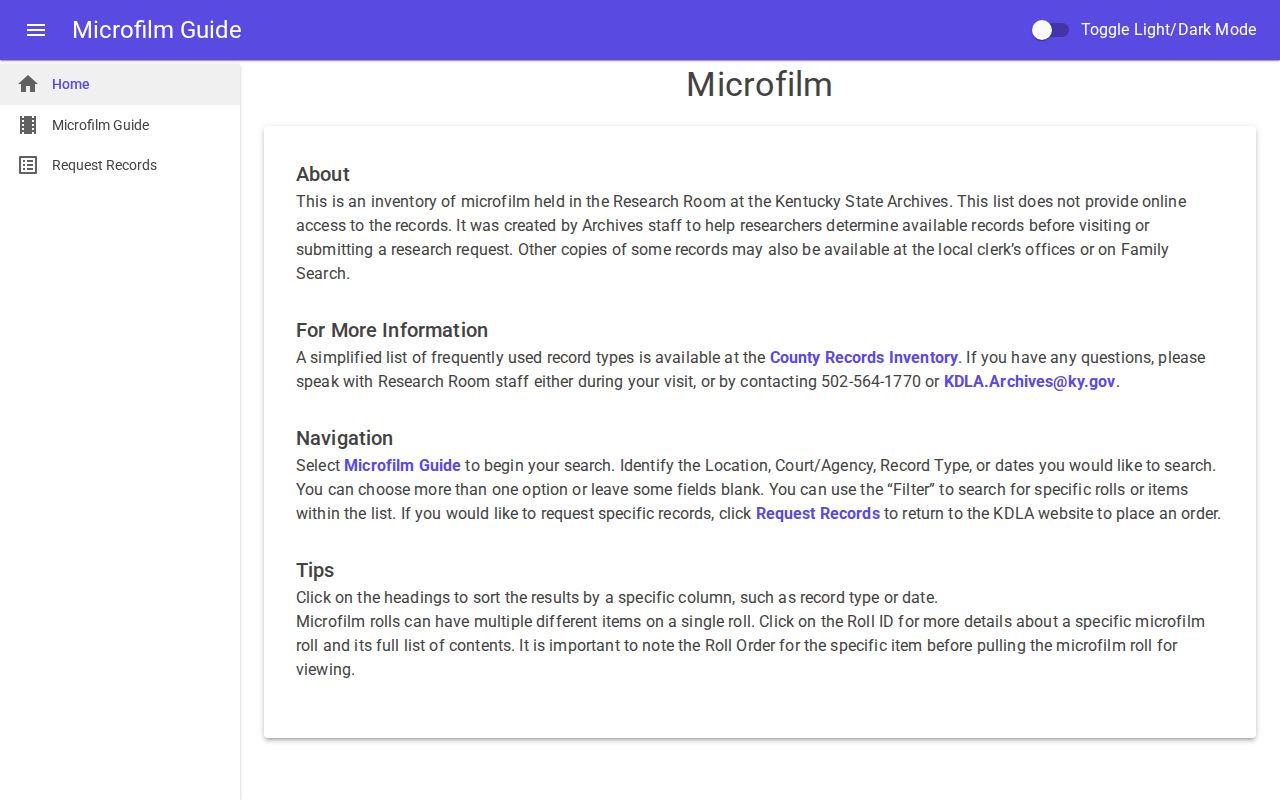
The guide lists which reels exist and how to order them. It is not itself a searchable set of deed images. Use it to identify the right reel first.
The 1864 and 1887 Disasters Require Caution
The KDLA county inventory lists Graves courthouse disasters in 1864 and 1887, plus deed material for 1887-2014, wills for 1888-2004 and county order books for 1899-1977. These dates guide repository checks. They prove neither total loss nor full survival. When a chain stops, broaden the search. Work through surviving indexes, deed books, order books and overlapping collections, since one series may fill gaps another left. The FamilySearch Kentucky catalog can reveal historical collections and finding aids. Use its details to locate a repository.
Use its collection details to locate a repository holding the reel you need. Then verify any transfer against the surviving official record before relying on it.
Probate Can Bridge a Broken Graves Name Chain
An owner's death can stop a deed sequence cold. Probate often bridges the gap. Search the decedent with estate, executor, administrator, trustee, heir and fiduciary variants. Graves probate material may disclose a will, inventory, order, settlement or sale authority. Land records may hold an executor's deed, commissioner's deed, affidavit of descent or later distribution instrument.
A death certificate is a separate identity source with its own access rules. It conveys no land. Library genealogy files and cemetery references can separate similarly named people. The recorded instrument or court order remains the parcel link.
Plat Cabinet B, Slide 66 Anchors a Local Chain
Thomas Country Estates shows why subdivision references outlast street changes. A 1989 restriction agreement cites Plat Cabinet B, Slide 66. A Public Service Commission docket also touches the development. Search the subdivision name, lot and plat citation. That connects previous owners when a postal label differs.
Other descriptions rely on acreage, creeks, roads or metes-and-bounds calls. Compare the prior deed, the recorded plat and the parcel shape before trusting any match. Never treat the PVA's abbreviated description as legal text.
Complete the Graves County Chain Without Guessing
Finish one transfer first. Identify the deed and parcel. Record both parties and preserve the citation. One person may have held several Graves County tracts, so the legal description decides which acquisition belongs, and changed acreage signals a split, combination, replat or partial conveyance.
Execution and recording dates often differ. Check corrected deeds too. Search both party roles around the period, and for copy mechanics see the deed records guide; for the present assessment owner, use the current-owner page.
Lawful research only. House history, estate work and purchase diligence are legitimate; never use former-owner information to stalk, harass or harm anyone.