
What Graves County Deed Records Convey
The Graves County Clerk's Legal Records Division records deeds. It also records mortgages, plats, releases, liens, and wills. Each deed names the parties, describes the property, and states the form of conveyance. The instrument type matters. Different documents carry different promises and grow out of different events. A recorded deed does not, by itself, settle every question about title.
| Instrument | What it accomplishes | Where it often appears |
|---|---|---|
| General warranty deed | Conveys the stated interest with broad title covenants | Ordinary arms-length sale |
| Special warranty deed | Limits warranties to the grantor's period of ownership | Institutional or estate-related transfer |
| Quitclaim deed | Transfers whatever interest the grantor has, without promising that an interest exists | Family transfer or correction |
| Executor, trustee or commissioner's deed | Conveys through a fiduciary or court-authorized actor | Estate, trust, foreclosure or judicial sale |
| Tax deed | Documents a transfer arising from delinquent-tax proceedings | Tax-sale history |
Not every filing conveys land. A mortgage or lien sits in the same records system, but it only encumbers the property. Always pull assignments, modifications, and releases tied to the original instrument. Otherwise an old filing can look like a burden. That burden may no longer exist.
ECCLIX Is Graves County's Online Deed Route
For remote deed work, the Clerk points researchers to ECCLIX/CCLIX online land records. Registration and payment are part of getting image and print access. The county publishes no detailed map of the site's dropdowns, sort controls, or current vendor charges, so rely on the party, date, document-type, and reference fields an actual session displays. Treat any search option you have not seen on screen as unconfirmed.
| Verified search clue | How to use it | Result to retain |
|---|---|---|
| Grantor or grantee | Try the name in both party roles | Indexed parties and transfer direction |
| Document type | Separate deeds from mortgages, liens and releases | Instrument category |
| Date range | Bracket a known sale or recording period | Recording date |
| Book/page or instrument number | Retrieve a known citation directly | Stable Clerk reference |
The Legal Records Division overview remains the authoritative statement of local holdings whenever the vendor interface changes. The Clerk's online-land-records page displays the official gateway and the DOC ALERT option.
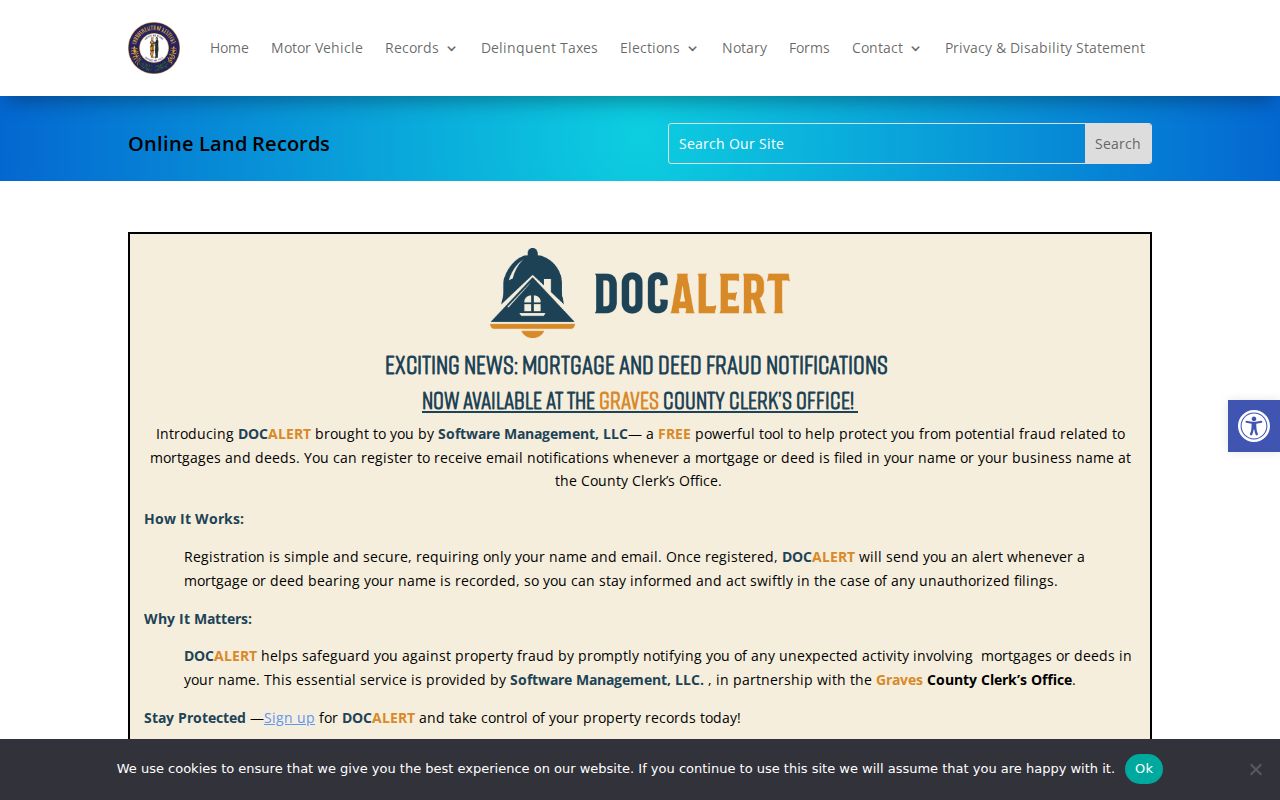
That page is a route into the system, not a substitute for reading the indexed deed itself. Note: Preserve punctuation, initials, and entity suffixes from the index, because small name differences can separate related deed records.
Three Dates Define Graves County Deed Access
Three dates shape deed access in Graves County. The Clerk maintains legal documents from 1902 to the present. Most indexes reach back to 1985 or earlier. Online images run from February 1997 forward. Each date describes a different layer, so an index hit may exist without a downloadable image, and a surviving older deed may sit outside the current local document run.
| Coverage marker | Meaning | Next move |
|---|---|---|
| 1902-present documents | Clerk's stated local legal-record span | Ask the Legal Records Division for the referenced instrument |
| Most indexes to 1985 or earlier | Name/reference searching extends behind the image window | Use the index citation at the counter |
| February 1997-current images | Stated online-image availability | Open or purchase through the current vendor terms |
| KDLA deeds 1887-2014 | Archival inventory overlaps and predates local coverage | Identify the series and microfilm roll |
An absent image is not an absent deed. It may mean only that the instrument predates the online imaging cutoff.
Follow the Graves Grantor-Grantee Chain
Begin with the newest credible conveyance instead of searching every surname in the dark. The PVA card can supply the present owner, the dotted parcel number, and an abbreviated legal description. From there, the deed index establishes the recorded transfer.
- Locate the latest deed with the current owner shown as grantee and confirm the parcel through its legal description.
- Record the grantor, grantee, recording date, deed type and book/page or instrument number.
- Search that grantor as a grantee in an earlier period to find how that person acquired the same land.
- Repeat, comparing acreage, lot and block, plat citations, road calls and adjoining owners at every step.
- When the online trail ends, carry the last citation to the Clerk counter or the archival series.
- Grantor
- The party conveying an interest.
- Grantee
- The party receiving the stated interest.
- Chain of title
- The ordered sequence of linked conveyances for the same land.
- Book/page or instrument number
- The recorder's document locator; retain whichever reference appears in the entry.
The legal description is the continuity check when addresses, parcel numbers, or acreage shift over time. A later split may cover only part of an earlier tract. Matching names alone never proves two entries concern the same land.
Check the Graves Clerk Fee Schedule Before Ordering
The current Clerk recording-fee schedule lists categories for deeds, mortgages, mortgage assignments, plats, releases, and liens. The schedule covers many land-document categories. A recording fee is not the same as a vendor's image charge. It also differs from the cost of a plain or certified copy. The official fee page shows the full range of land-document categories the office handles. Ask which service you need before sending payment. Request a current total, especially for a multi-page instrument.
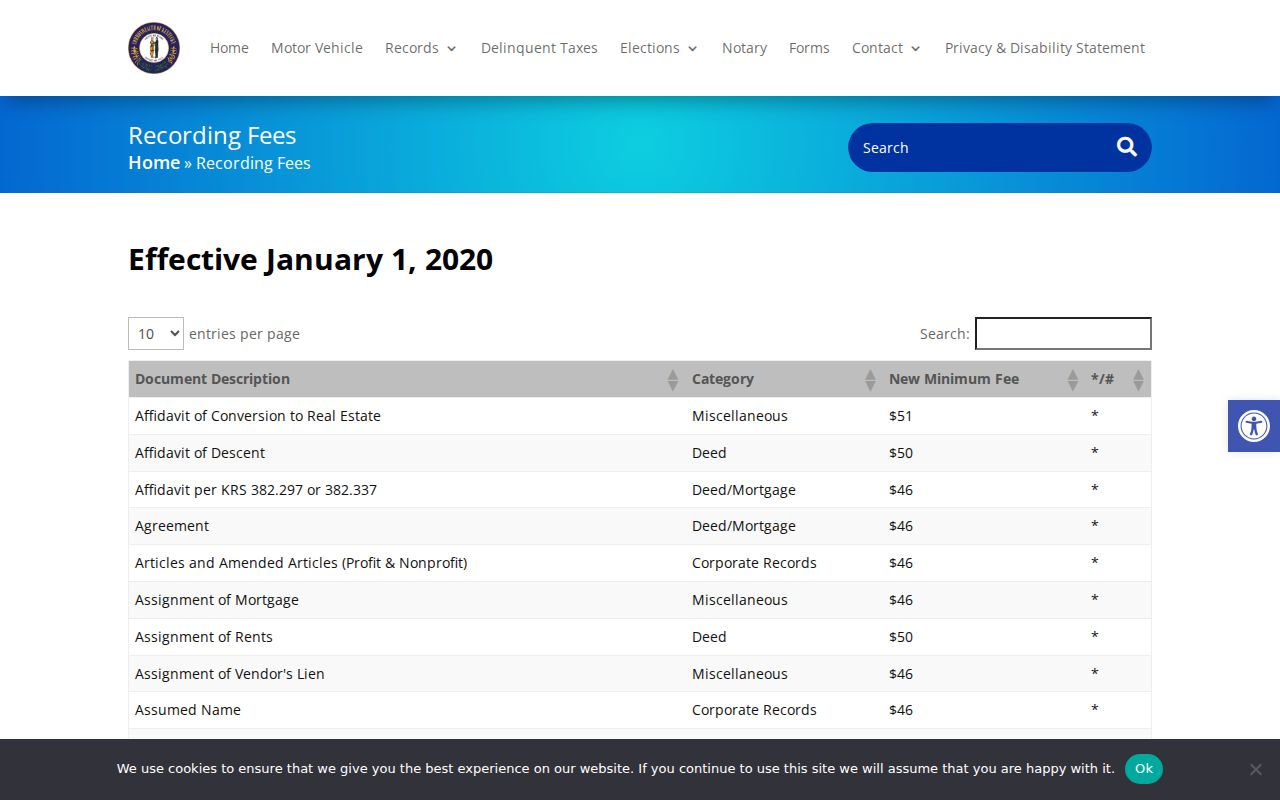
Recording a new instrument, viewing an existing image, and obtaining a certified copy are three separate transactions. Each carries its own cost.
Courthouse Disasters Complicate the Early Deed Trail
The Kentucky Department for Libraries and Archives county inventory lists Graves courthouse disasters in 1864 and 1887. It also shows a deed run beginning in 1887. Those facts do not mean every earlier book burned or every later item survives. A negative result is a prompt, not a conclusion. Compare surviving deed books, county order books, reconstructed indexes, and overlapping repositories before giving up. The KDLA microfilm guide searches by county, office, record series, and date range. A single reel may hold several items. So note the roll identifier and item order before requesting it. The FamilySearch Kentucky collection catalog offers another finding route. The Clerk remains the custodian for current official copies. Note: Archival coverage dates identify holdings. They do not promise that a deed image is freely viewable online.
Lot and Plat References Keep the Same Land in View
Subdivision deeds often cite lot, block, cabinet, and slide references. They may do this rather than a modern street address. Thomas Country Estates offers a Graves County example. A 1989 restriction agreement cites Plat Cabinet B, Slide 66, and a Public Service Commission utility docket adds related development history. Search the subdivision name and plat reference, then compare the deed's lot and easement language. Metes-and-bounds descriptions follow bearings, distances, and monuments instead. The PVA or GIS summary helps locate the tax parcel. However, the sample card warns that its legal-description text is not for use on legal documents. For a boundary dispute, obtain the recorded deed and plat and consult a qualified surveyor.
Graves County DOC ALERT Watches Filed Names
The Clerk offers free DOC ALERT sign-up through its online land-records page. You register a personal or business name plus an email. After that, Graves County sends notice. It fires whenever a deed or mortgage is recorded under that name. It works well as an early warning. A stray filing you never authorized gets flagged fast. Name matching can also trigger harmless alerts, though. The system says nothing about legal validity of an instrument.
Treat an alert as a starting point, not proof. Open the indexed entry and compare the parties and property description against what you know. Then pull the recorded image. Or get a certified copy of the deed before taking any action. If an instrument looks genuinely suspicious, report it to the Clerk, law enforcement, or your attorney. An alert alone is never a title opinion.
Obtain a Graves County Deed Online or at the Counter
ECCLIX is the right tool when the deed you need falls inside its online coverage. Older entries may have no image attached. In that case, contact the Graves County Clerk at 1102 Paris Road, Suite 4, Mayfield, KY 42066, or call (270) 247-1676 with the parties, the recording date, and the book/page or instrument number. The Clerk's open-records policy also lays out a written-request route for identifiable agency records. Kentucky's Act generally requires a response within five working days, subject to exemptions and any lawful extension.
For pre-image deeds, work the sequence in order. Start with the online index. Move to the Clerk counter or a written request. If local retrieval cannot bridge the date gap, turn to the KDLA inventory and microfilm. Always ask up front whether your use calls for an informational copy or a certified one.
Recorded, not guaranteed. Graves County deed records show filed instruments, not every possible unrecorded interest or defect. A professional title examination answers the legal title question.